Inside the PortableMind Updater: The Machine That Rewrites the Machine
A PortableMind never needs an update. That is the deal and we are proud of it: the drive you bought keeps working exactly as it is, offline, forever, with nothing forced on you. But when a build like 1.8.0 lands and you want it, a genuinely hard engineering problem wakes up: the drive is in your hands now, not ours. We cannot see it, we cannot touch it, and we get exactly one chance to rewrite it without losing your conversations or leaving you holding a dead stick. The PortableMind Updater is our answer, and it is original engineering top to bottom. The filesystem writer, the cryptographic delivery envelope, the licensing state machine, the destructive-write safety model: none of it is a wrapped library or a forked tool. This post walks the whole stack, names each invention, and is honest about the one thing we will not do, which is publish the internals.
TL;DRThe PortableMind Updater is a fully in-house system for safely reflashing AI drives in the field: a byte-level exFAT filesystem writer built from the Microsoft spec, per-customer encrypted build delivery in signed envelopes, server-side license and tier enforcement, and a safety model where an interrupted update is a retry, not a brick. Free for every customer, one screen, conversations preserved.
The problem: rewriting hardware we no longer control
Most software updates itself in place: swap some files, restart, done. PortableMind cannot work that way. The product is a bootable, encrypted, multi-gigabyte AI stack living on a physical drive, and an update has to replace essentially all of it, over a home internet connection, on a computer we have never seen, driven by a person who may have never updated firmware in their life.
Get that wrong one way and a customer loses their conversations. Get it wrong the other way and their drive is a paperweight. Get it wrong a third way and someone who never bought the product is downloading our firmware. The Updater exists to make all three failure modes structurally impossible to stumble into, and every layer of it was built in-house to serve that exact goal.
Reflash, not patch
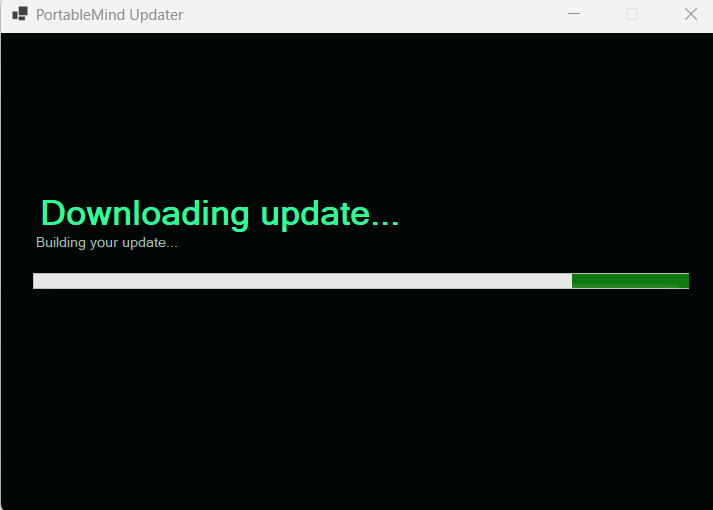
The first design decision is the one everything else hangs on: the Updater does not patch drives, it rebuilds them. Your conversations and settings are backed up, the drive is rewritten end to end as a complete, verified image of the new firmware, and your data is restored on top. Every updated PortableMind leaves the process in a known, factory-clean state.
Patching would have been easier to build. It also accumulates drift: every patched drive becomes a slightly different machine, and a year of patches means a support matrix of thousands of unique states. Reflash-not-patch means the drive you updated last night and the drive we flashed by hand this morning are byte-for-byte siblings. When something needs debugging, there is exactly one build to reason about per tier, per version.
The filesystem writer we had to write ourselves
Here is the part that surprises engineers: the Updater does not format drives by calling the operating system, and it does not wrap an existing imaging tool. It writes the exFAT filesystem itself, byte by byte, from a hand-rolled implementation of the Microsoft exFAT specification. Boot region checksums, up-case tables, FAT chains, directory entry sets: all of it is assembled from first principles in our own code.
We did not do that for sport. No existing tool could do what the product requires: assemble a per-customer filesystem image, encrypted, personalized to a tier and a specific drive, and stream it into place as it downloads instead of staging a full second copy. The moment your requirements include building the filesystem inside a pipeline that never holds plaintext at rest, every off-the-shelf option falls away, and you are left reading the spec and writing a filesystem.
Sealed envelopes, and a server that trusts no one
Delivery is its own invention. Updates travel as a signed, versioned envelope carrying two sealed payloads, and the client that receives it is never trusted with more than it needs. Licensing runs through a claim, token, and hardware-binding state machine on our servers: which drive you own, what tier it is, and what it is entitled to are enforced server-side, per unit, with secrets that rotate per unit as well. A copied download is useless, a replayed request is useless, and lying to the client accomplishes nothing because the client was never the authority.
This is also the part of the post where we stop describing things. We are naming these layers because we are proud of them; we are not documenting them, because the protocol details, formats, and key handling are exactly the trade-secret core a competitor would need. The honest version of security writing is naming what exists and keeping the blueprints in the vault, and that is the deal here.
The point of no return, labeled in plain English
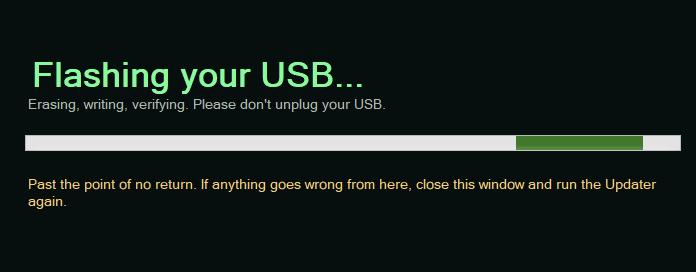
Destructive writes are sorted into an explicit safety taxonomy: what can be verified before it happens, what can be undone, and what cannot. Everything reversible happens first. The Updater identifies the exact drive, backs up your conversations, downloads and verifies the complete build, and only then crosses into the irreversible phase, which it announces on screen in the plainest language we could write.
And because the rebuild is total, even the worst case is boring: if the power dies or the cable drops mid-flash, the drive is simply mid-rebuild. Run the Updater again and it rebuilds again from the verified image. An interrupted update is a retry, not a brick, and your conversations are still in the backup either way. That property is not luck; the whole write order was designed backwards from it.
Past the point of no return. If anything goes wrong from here, close this window and run the Updater again.The actual on-screen copy, mid-flash
All of that, behind one screen
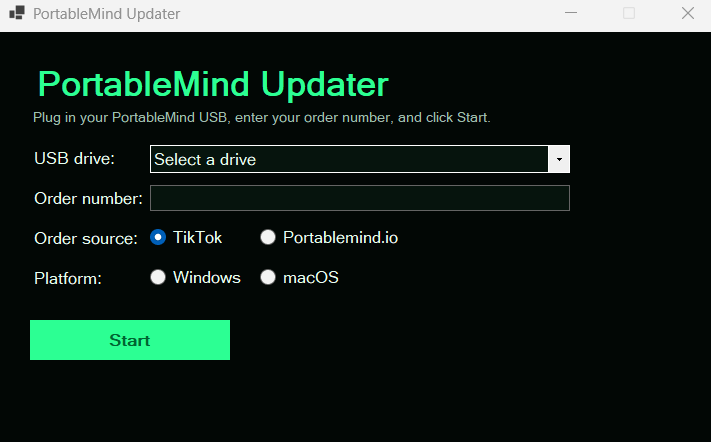
The customer-facing surface of this entire system is one window: pick your drive, type your order number, choose where you bought it, click Start. That includes customers from the very beginning; drives sold before the modern licensing system existed get verified through their order records instead, automatically, on the same screen. No account creation, no serial-number archaeology, no support ticket required.
That is the point of building all of it in-house. Complexity does not disappear, it just has to live somewhere, and we chose to make it live on our side of the wire. The Updater download is a single zip with two files and no installer, and the update itself is free, optional, and always will be for the drive you bought.
Why it matters that this is ours
The Updater is integrated end to end with our own signing keys, our own per-tier build pipeline, our own licensing and hardware-binding scheme, and our own server infrastructure. It is not a plugin, not a fork, not a wrapped SDK with our logo on it. That matters for two reasons.
First, trust: when one team owns the whole chain from build server to the last byte on your drive, there is no third party in the middle to compromise, misconfigure, or quietly change terms. Second, durability: the hard problem here, safely and remotely rewriting consumer hardware with zero data loss and no opening for a bricked device or an unlicensed copy, had to be solved from scratch. Anyone who wants what the Updater does has to solve all of it from scratch too. It is the same offline-first, own-the-whole-stack philosophy as the drive itself, applied to the one moment the product touches the internet.
Use it
If you own a Windows-based PortableMind, the official Updater brings it to Firmware 1.8.0 today, with SCOUT's seven field modes and the faster runtime, free. Plug in, order number, Start, and come back to a factory-fresh drive that still remembers every conversation you ever had with it.
Ready to run AI offline?
PortableMind is the plug-and-run offline AI USB. Go Digital for $69 and flash your own drive, or get the $99 v1.8.0 USB (voice, SCOUT Vision field modes, multi-modal chat, in-app Model Manager) or MAX-SPEED for power users. No internet, no subscription.
Conclusion
Most companies treat their updater as plumbing. Ours is a product-grade system we consider part of the product: an original filesystem writer, an original delivery protocol, an original safety model, all pointed at one promise, that the drive in your hand can always become the newest PortableMind without risking the conversations on it. Three fields and a Start button, with a decade's worth of hard problems solved behind them.
Update your PortableMind →Frequently asked questions
Long-tail answers for the search queries around this topic.
- What is the PortableMind Updater?
- The official, free tool that brings any Windows-based PortableMind USB to the latest firmware. It is a single downloaded zip with no installer: pick your drive, enter your order number, click Start, and it rebuilds the drive on the newest build with your conversations preserved automatically.
- Can an update brick my PortableMind?
- The system is designed so an interrupted update is a retry, not a brick. The Updater rebuilds the drive from a complete verified image, so if power or the connection dies mid-flash, you run it again and it rebuilds again. Your conversations sit safely in a backup through the whole process.
- Why does PortableMind reflash the whole drive instead of patching?
- A full rebuild means every updated drive ends in a known, factory-clean state, identical to a fresh unit on the same tier and version. Patching accumulates drift and multiplies failure states. Reflash-not-patch trades bandwidth for reliability, and reliability wins.
- Does the Updater see my conversations?
- Your conversations are backed up and restored as part of the update, and they stay yours. The licensing system verifies which drive you own and what tier it is; it has no business in your chat history and takes none.
- Do firmware updates cost anything?
- No. Updates for the drive you bought are free and optional, always. Your PortableMind keeps working exactly as it is whether you ever update or not.
- Why did you write your own exFAT filesystem code?
- Because no existing tool could assemble per-customer, per-tier filesystem images encrypted and streamed the way the product requires. The Updater's exFAT writer is a byte-level, from-the-spec implementation: boot checksums, up-case tables, FAT chains, and directory entries, all built in-house.
- I bought my PortableMind a long time ago. Can I still update?
- Yes. Units from before the modern licensing system get verified through their order records instead, on the same screen with the same Start button. Have your order number from TikTok Shop or portablemind.io handy.
- Is the Updater available for macOS-based units?
- Not yet. Today's Updater is for Windows-based PortableMinds; the macOS update path is coming and will be announced. If your unit runs macOS, hold off rather than running the Windows updater on it.
Carson Dresser created the first offline AI USB. He builds from South Florida, where hurricane season makes losing power a lived reality rather than a thought experiment, and he watched cloud AI fail people at the worst possible moments: locked accounts, surprise price hikes, assistants that vanish with the signal. In 2025 he decided intelligence should be something you own, and shipped it. Working alone, he engineered the firmware, tuned the local models, wrote the desktop app, and built the over-the-air update system that delivers cryptographically signed payloads to drives already in the field. He also designed the product, built this website, and runs the store, the kind of range that usually takes a company. Before PortableMind he built ClipStitcher and a stack of practical automations for creators and small operators. Every order that ships and every support email still goes through Carson personally.